And so to the fourth and final part of our round -up of the May and June World Cup 2010 qualifiers. Today we cover the Asia and Oceania sections...
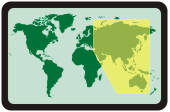 AsiaOverview
A complicated process here. In Round 1, thirty-eight teams faced each other in nineteen home-and-away matches. Of the nineteen winners, the eleven highest-ranking teams (and by that we think FIFA mean those teams that won by the biggest margins) received a bye to Round 3 while the other eight played out Round 2 as a series of four home-and-away ties.
The winners of those games advanced to Round 3 where they went into the hat with the eleven biggest winners from Round 1 and the top five seeded teams overall who were given a bye (among whom were Australia, Japan and South Korea). These 20 teams were then drawn into five round-robin groups of four where the winners and runners-up go through to Round 4. (Just for the record, Round 3 has just finished - more of which shortly - and Round 4 gets underway on September 6th).
Finally in Round 4, the ten remaining teams are split into two round-robin groups of five. The winners and runners-up from both groups will qualify for World Cup 2010, while the two third-placed teams go into a home-and-away play-off. The winner of that play-off... does NOT qualify for the World Cup Finals, oh no - for them there's the agony of one more play-off against the top team from Oceania.
Then and only then will we know all the Asian teams going through to South Africa 2010... by which time qualification for World Cup 2014 will probably be underway, but never mind...
NewsSo as mentioned before, Round 3 came to an end towards the end of June and of all the five groups involved,
Group 1 was easily the toughest fought. In it were Asian champions
Iraq,
Australia - relative newcomers to the Asian zone and one of the favourites, 2002 World Cup finalists
China and the never-to-be-overlooked threat of
Qatar.
If we say that none of the four teams managed to win any more than there of their six games, that should give you a measure of their collective lack of consistency. Australia seemed to make the best start with wins over Qatar and Iraq and a draw against China, but defeats to China and Iraq were to follow soon after and the Aussies were by no means certain of finishing in the top two going into the final round of games.
Fortunately for them, the threat from Iraq fizzled out in the last game of the group as Qatar gained a vital three points to snatch the runner-up spot in the group. Though they'd lost in both matches to the Australians, Qatar did well against the other teams in the group, and with China's only win coming in their last game against Australia, it was the Aussies and Qatar (above right) that booked their place in Round 4.
Group 2 had one clear favourite in the shape of
Japan, and they didn't disappoint, topping the group with thirteen points from a possible eighteen. That meant there'd be a bit of a surprise in finding out who would take second spot in the group, and it would eventually go to
Bahrain.
For them, the battle was won in the first half of their campaign, winning their opening three games against all of their opponents. The only team likely to stop them were
Oman, but their challenge was never a strong one so Bahrain were home and hosed going into their last match against Japan who had already qualified.
Thailand finished last in the group with just one point, picked up from their home match against Bahrain.
Group 3, similarly, had two front runners of its own and with a pleasant sense of symmetry and international accord, both qualifiers came from either side of the Korean border. Shoot, they even finished on the same amount of points in the end. Beat that, Ban Ki-moon.
Yes, it was a
Korean one-two in the end with the
South blazing their way to the top of the group unbeaten and scoring ten goals while conceding only three. The
North matched them point for point, winning three and drawing the other three of their games, but they had a much more economical approach. They scored just four and didn't concede any. I think that's what's known as a 'mean defence', isn't it?
The other two teams in the group,
Jordan and
Turkmenistan, could hardly get a look in and had to make do with trying to score points off each other. This turned out to be a fruitful exercise for Jordan who beat the Turkmen 2-0 on both occasions, but neither could get any more than a single point off the two Koreas.
And so it ended with South Korea top and North Korea second, split only on goal difference, with Jordan finishing third, five points behind and Turkmenistan last on just one. And you might be wondering how those peace-loving Koreans faired when they played each other? The answer: both games ended goalless. How very amicable.
There was another two-horse race in
Group 4, this time won easily by
Saudi Arabia and
Uzbekistan, well ahead of
Singapore and
Lebanon. The two favourites made light work of their opponents, both winning five out of their six games. Their only defeats would turn out to be against each other.
Singapore's six points came from both their wins over the hapless Lebanese team who ended their campaign with a big fat zero in the Points column, but at least they can rest assured they didn't suffer the biggest humiliation of the competition. That undoubtedly went to Singapore who lost 7-3 at home to Uzbekistan despite being level at 2-2 just half an hour into the game.
Finally to
Group 5 where
Iran and the
United Arab Emirates were expected to be the runaway favourites, but only Iran lived up to their reputation. Despite a slow start, Iran finished their campaign with three draws and three wins and comfortably topped the group on twelve points.
The UAE, however, were less sure of themselves. They had to fight off the attentions of
Syria who were also struggling to gain any consistency and as the competition wore on, the daylight between them grew less and less. It was with considerable irony, then, that both teams met each other in a do-or-die game to decide the final qualifying spot in the group.
Syria needed to beat the Emirates by three clear goals to go above them on goal difference. Adopting a predictably offensive strategy, Syria went 2-0 up thanks to a goal either side of half time from Jehad Al Houssain, but with just seven minutes left on the clock, any hopes the Syrians had of winning came to an abrupt end. UAE striker Ismail Matar converted a penalty to pull the score back to 2-1, and though Syria picked up a third through Firas Al Khatib a minute from time, it was not enough. The United Arab Emirates were through to the next round by a single goal and the gallant Syrians were out.
With the ten qualifying teams known, the draw was made for the two Fourth Round groups, and here's how the teams fell into place:

At first glance, Group 2 appears to be the toughest, containing three of the five group winners from the previous round. It also features the inseparable pairing of North and South Korea along with the tough Uzbekis, although Group 1 will see a fascinating re-enactment of the Australia / Qatar tussle with Japan thrown in for good measure, too.
By way of a prediction, we're going for Uzbekistan, Japan, South Korea and Saudi Arabia as the four automatic qualifiers with Australia and the United Arab Emirates entering the Round 5 play-off. If that's the way it all pans out, you can expect some great games and some shocks along the way...
OceaniaBackgroundEasy-peasy, this. Nine teams started out in Round 1 (ten, if you include the non-FIFA affiliated Tuvalu), and from them, three progressed to Round 2 to join the seeded New Zealand.
In Round 2, all four teams play in a round-robin group and the winning team goes through to a play-off against the fifth best team from Asia.
NewsAs you'd expect,
New Zealand are the hot favourites to represent Oceania in that Asian play-off and so far they've won all three of their games to lead the group.
New Caledonia (seen right against Tuvalu) are only a point behind them at the moment, but they've played an extra match and the other two teams,
Fiji and
Vanuatu trail way behind with just a point each.

So the big question is 'when do New Zealand and New Caledonia play each other next'? Well as luck would have it, that's on September 6th in Noumea and if the All Whites win, they'll have virtually booked their place in the Asian play-off. Only a win for New Caledonia in the second match against New Zealand four days later and a loss for New Zealand against Fiji in November will provide any opportunity for the New Caledonians to succeed.
And that's that. All the qualifiers thus far have now been covered, but there are more on the way during the next month or so and you can bet we'll be back to give you news of those when they happen. Hopefully this time you won't have to wait so long for them, if you're lucky...


 All in all, the Japanese find themselves under a cloud of feint despair going into this summer’s competition. With a coach no-one seems to like and a draw that barely encourages optimism, Japan can be excused if they appear to be going through the motions this time around, but each qualification brings with it experience and knowledge. With that in mind, along with a more inspiring coach and a little bit of luck, perhaps 2014 will be their year.


