Final Destination
The 10 Stadia That Have Hosted The European Cup/Champions League Final Most Often
1. Wembley Stadium, London - 5 times (1963, 1968, 1971, 1978, 1992)
2. Heysel Stadium, Brussels - 4 times (1958, 1966, 1974, 1985)
3. Stadio Olimpico, Rome - 4 times (1977, 1984, 1996, 2009)
4. Hampden Park, Glasgow - 3 times (1960, 1976, 2002)
5. Olympiastadion, Munich - 3 times (1979, 1993, 1997)
6. Olympic Stadium, Athens - 3 times (1983, 1994, 2007)
7. Parc Des Princes, Paris - 3 times (1956, 1975, 1981)
8. Prater Stadium, Vienna - 3 times (1964, 1987, 1990)
9. San Siro, Milan - 3 times (1965, 1970, 2001)
10. Santiago Bernabéu, Madrid - 3 times (1957, 1969, 1980)

Showing posts with label stadia. Show all posts
Showing posts with label stadia. Show all posts
Friday, 21 May 2010
Friday, 16 April 2010
The Friday List of Little or No Consequence #160
Grounds for sharing
25 Instances Of European Football Clubs Sharing A Stadium
1. SK Sturm Graz and Grazer AK (UPC-Arena, Austria)
2. Club Brugge and Cercle Brugge (Jan Breydel Stadium, Belgium)
3. FC Inter and Turun Palloseura (Veritas Stadion, Finland)
4. Bayern Munich and 1860 Munich (Allianz Arena, Germany)
5. AEK Athens and Panathinaikos (Olympic Stadium, Greece)
6. Galway United and Mervue United (Terryland Park, Ireland)
7. Milan and Inter (Stadio Giuseppe Meazza 'San Siro', Italy)
8. Roma and Lazio (Stadio Olimpico, Italy)
9. Chievo and Verona (Stadio Marc'Antonio Bentegodi, Italy)
10. Genoa and Sampdoria (Stadio Luigi Ferraris, Italy)
11. Juventus and Torino (Stadio Olimpico di Torino, Italy)
12. Atalanta and AlbinoLeffe (Stadio Atleti Azzurri d'Italia, Italy)
13. Lyn and Skeid (Bislett Stadion, Norway)
14. Louletano DC and SC Farense (Estádio Algarve, Portugal)
15. Torpedo Moscow and Spartak Moscow (Luzhniki Stadium, Russia)
16. Dynamo Moscow and CSKA Moscow (Dynamo Stadium, Russia)
17. FC Ljubljana and NK Interblock (ZSD Ljubljana, Slovenia)
18. Hércules CF and Alicante CF (José Rico Pérez, Spain)
19. IFK Norrköping and IK Sleipner (Idrottsparken, Sweden)
20. IFK Göteborg, GAIS and Örgryte IS (Gamla Ullevi, Sweden)
21. IF Elfsborg and Norrby IF (Borås Arena, Sweden)
22. Halmstads BK and IS Halmia (Örjans vall, Sweden)
23. FC Zürich and Grasshopper-Club Zürich (Letzigrund, Switzerland)
24. Altay and Göztepe (İzmir Atatürk Stadyumu, Turkey)
25. Dynamo Kyiv and Arsenal Kyiv (Lobanovsky Dynamo Stadium, Ukraine)
25 Instances Of European Football Clubs Sharing A Stadium
1. SK Sturm Graz and Grazer AK (UPC-Arena, Austria)
2. Club Brugge and Cercle Brugge (Jan Breydel Stadium, Belgium)
3. FC Inter and Turun Palloseura (Veritas Stadion, Finland)
4. Bayern Munich and 1860 Munich (Allianz Arena, Germany)
5. AEK Athens and Panathinaikos (Olympic Stadium, Greece)
6. Galway United and Mervue United (Terryland Park, Ireland)
7. Milan and Inter (Stadio Giuseppe Meazza 'San Siro', Italy)
8. Roma and Lazio (Stadio Olimpico, Italy)
9. Chievo and Verona (Stadio Marc'Antonio Bentegodi, Italy)
10. Genoa and Sampdoria (Stadio Luigi Ferraris, Italy)
11. Juventus and Torino (Stadio Olimpico di Torino, Italy)
12. Atalanta and AlbinoLeffe (Stadio Atleti Azzurri d'Italia, Italy)
13. Lyn and Skeid (Bislett Stadion, Norway)
14. Louletano DC and SC Farense (Estádio Algarve, Portugal)
15. Torpedo Moscow and Spartak Moscow (Luzhniki Stadium, Russia)
16. Dynamo Moscow and CSKA Moscow (Dynamo Stadium, Russia)
17. FC Ljubljana and NK Interblock (ZSD Ljubljana, Slovenia)
18. Hércules CF and Alicante CF (José Rico Pérez, Spain)
19. IFK Norrköping and IK Sleipner (Idrottsparken, Sweden)
20. IFK Göteborg, GAIS and Örgryte IS (Gamla Ullevi, Sweden)
21. IF Elfsborg and Norrby IF (Borås Arena, Sweden)
22. Halmstads BK and IS Halmia (Örjans vall, Sweden)
23. FC Zürich and Grasshopper-Club Zürich (Letzigrund, Switzerland)
24. Altay and Göztepe (İzmir Atatürk Stadyumu, Turkey)
25. Dynamo Kyiv and Arsenal Kyiv (Lobanovsky Dynamo Stadium, Ukraine)
Friday, 3 October 2008
The Friday List of Little or No Consequence #81
Wembleys-in-waiting
The 15 Non-League Clubs With The Biggest Stadium Capacities
1. St. Helens Town (North West Counties, Premier Division) - 17,500
2. Wrexham (Conference National) - 15,500
3. Newcastle Blue Star (Northern Premier, Division One North) - 13,500
4. Oxford United (Conference National) - 12,500
5. Gateshead (Conference North) - 12,000
6. Mansfield Town (Conference National) - 10,000
7. Leigh Genesis (Conference North) - 10,000
8. Cambridge United (Conference National) - 9,617
9. York City (Conference National) - 9,606
10. Bath City / Team Bath (Conference South) - 8,800
11. Silsden (North West Counties Premier Division) - 7,800
12. Grantham Town (Northern Premier, Division One South) - 7,500
13. Stevenage Borough (Conference National) - 7,100
14. Boston United (Northern Premier, Premier Division) - 6,643
15. Weymouth (Conference National) - 6,600
Of the clubs listed above, four share their ground with rugby teams (St. Helens Town, Newcastle Blue Star, Leigh Genesis and Silsden) while Gateshead play at the Gateshead International athletics stadium. Wrexham currently have the largest football-only stadia outside the top four tiers in England and Wales.
The 15 Non-League Clubs With The Biggest Stadium Capacities
1. St. Helens Town (North West Counties, Premier Division) - 17,500
2. Wrexham (Conference National) - 15,500
3. Newcastle Blue Star (Northern Premier, Division One North) - 13,500
4. Oxford United (Conference National) - 12,500
5. Gateshead (Conference North) - 12,000
6. Mansfield Town (Conference National) - 10,000
7. Leigh Genesis (Conference North) - 10,000
8. Cambridge United (Conference National) - 9,617
9. York City (Conference National) - 9,606
10. Bath City / Team Bath (Conference South) - 8,800
11. Silsden (North West Counties Premier Division) - 7,800
12. Grantham Town (Northern Premier, Division One South) - 7,500
13. Stevenage Borough (Conference National) - 7,100
14. Boston United (Northern Premier, Premier Division) - 6,643
15. Weymouth (Conference National) - 6,600
Of the clubs listed above, four share their ground with rugby teams (St. Helens Town, Newcastle Blue Star, Leigh Genesis and Silsden) while Gateshead play at the Gateshead International athletics stadium. Wrexham currently have the largest football-only stadia outside the top four tiers in England and Wales.
Friday, 14 December 2007
The Friday List of Little or No Consequence #42
The parachutist's view...
7 Well-known Football Stadia As Seen From The Air
1. Azteca Stadium, Mexico City

2. Hampden Park, Glasgow

3. Maracana Stadium, Rio de Janeiro

4. Monumental Stadium, Buenos Aires

5. Nou Camp, Barcelona

6. Olympic Stadium, Rome

7. Santiago Bernabeu, Madrid

7 Well-known Football Stadia As Seen From The Air
1. Azteca Stadium, Mexico City

2. Hampden Park, Glasgow

3. Maracana Stadium, Rio de Janeiro

4. Monumental Stadium, Buenos Aires

5. Nou Camp, Barcelona

6. Olympic Stadium, Rome

7. Santiago Bernabeu, Madrid

Saturday, 3 November 2007
World Cup 2018: Who's got the stadia?
To continue this week's main theme, i.e. The 2018 World Cup and who may end up hosting it, I decided to look into the stadia that might be used in each of the countries showing an interest.
Now that England have officially thrown their hat into the ring, it's tempting to suggest that if FIFA asked the FA to host the competition, the least significant problem would be finding a dozen superior stadia. Such is the development of the Premier League that venues are of an excellent standard these days, but would they all be capable of accommodating a sufficient number of people?
In Germany last year, the lowest stadium capacity of the twelve used was that belonging to FC Nürnberg which could house just under 42,000. The average capacity of all twelve was just under 53,000. So let's apply that to the Premier League. Which stadia would get the nod?
The answer: those belonging to Manchester United, Arsenal, Newcastle United, Sunderland, Manchester City, Liverpool, Aston Villa and Chelsea. Add the new Wembley Stadium onto that and you have nine, which leaves us three short.
It's been suggested that Leeds United, Sheffield Wednesday and Nottingham Forest could put forward their grounds for use, but even they fall short of the 42,000 target mentioned earlier, albeit only just. Perhaps the proposed new homes for Everton and West Ham could be used instead (if they're built by then)?
It's almost certain that England will be there or thereabouts when it comes to having the required number of good-sized stadia. They're also relatively well spread apart, geographically speaking, although a few of them are bunched together in the same cities. Ho hum... So what about the other contenders?
If you take Russia's best 12 stadia that are capable of hosting football matches, ten of them are currently in use by football teams at the moment and of the other two, one is Moscow's Olympic Stadium (left) and the other is a multi-use stadium in St.Petersburg. The trouble is, five of them are in Moscow, and only three are above that 42,000 capacity total. Some of them have capacities below 29,000.
Looks like the Russians have got some work to do if they're to give us some decent places to watch our football in.
The Australians have got a strong case. They're riding on the crest of a wave following their progress to Round 2 of last year's World Cup and they've never hosted the competition before. They did host the Olympic Games back in 2000 and made a fine job of it... but what about their stadia?
In Australia, if you bump into a sporting venue it's likely to be purpose built for either soccer, rugby, Australian Rules football or cricket, and therein lies a slight problem. Although most of the usable stadia 'down under' are well above the required size, many of them would require a little modification. Places like The Gabba, the SCG and the MCG have hosted soccer matches before and have the potential to hold considerable crowds, but the oval or round pitches mean that without some changes here and there someone's going to have a rather distant view of the game.
As for the stadia used by teams in the A-League, some would be suitable such as the Telstra Stadium in Melbourne and the Sydney Football Stadium, but most of the others are of a far smaller size. It should at least be interesting to see how Australia deals with this scenario and the building of a few new venues may well be required by the looks of things.
The United States hosted the World Cup not so long ago in 1994 and back then nine stadia were used, all of which had a capacity of 57,000 or more. They could all be used again in 2018 if necessary, yet the staggering thing is the USA could actually put into use twelve venues with a capacity of 70,000 or more if they wanted to.
Huge stadia are not hard to come by in the States as many are used for American Football, either at college or professional level. Some, as seen in 1994, can be used for soccer too - think Giants Stadium and the Soldier Field. If they all could be converted to host soccer matches (which at the moment I see no reason why not), you'd potentially end up with the highest aggregate crowd figures for any World Cup in history.
If, however, you look at their top-flight club stadia, as in Australia, the figures aren't quite so impressive. Most are in the 20-30,000 capacity range and wouldn't be suitable for a competition the size of the World Cup.
Still, plenty for the Americans to be optimistic about there, thanks to the groundwork laid down in the world of Gridiron, and they're all nicely spaced out across a vast area. Can the same be said of China?
The answer is yes. In fact from what I can make out China looks like being the one country that can tick all its boxes when it comes to stadia. Of all the venues that are available for football there, most need no modifications as they're being used for football already, the rest are generally multi-use stadia (so no great problems there), they'd all be well over 40,000 in capacity and they're all well located in different cities (with the exception of a couple that are located in Beijing).
More good news for the Chinese is that the new stadium has been built in the capital for next year's Olympic Games which will hold 80,000 people after the event, and the Guangdong Stadium that will host the 2010 Asian Games has the capacity to welcome 82,000 people into its stylised and cavernous structure.
All of which leaves the joint bid by Belgium, Luxembourg and the Netherlands (if they so choose to get together). FIFA are still a little dubious as to the benefits of having two co-hosts after the Japan & South Korea venture had a slightly diluted geographical impact, so to have three countries co-hosting may prove a bridge too far.
Anyway, the Netherlands and Belgium have done all this once before in 2000 when they co-hosted the European Championships. Seven years ago, they both stumped up four stadia each but while three of them had a 50,000+ capacity, the other five were able to house more like 30,000.
Since 2000, nothing's changed - no new stadia have been built therefore you're left thinking that with only three good-sized stadia to use, the Benelux bid will be somewhat weak and in need of much building work to be done across both countries.
And did we mention Mexico? Probably not, but then that's because (a) they've already hosted the competition twice, and (b) out of the five large-capacity stadia they have, three are in Mexico City. Don't even think about it, Mexico...
And that, my friends, is that. If I were a betting man, I'd say the 2018 World Cup hosting competition was a straight three-horse race between China, the USA and England. My brain says it'll be China, my sixth sense suggests it'll be America, but my heart... well, you can probably guess the rest.
Now that England have officially thrown their hat into the ring, it's tempting to suggest that if FIFA asked the FA to host the competition, the least significant problem would be finding a dozen superior stadia. Such is the development of the Premier League that venues are of an excellent standard these days, but would they all be capable of accommodating a sufficient number of people?
In Germany last year, the lowest stadium capacity of the twelve used was that belonging to FC Nürnberg which could house just under 42,000. The average capacity of all twelve was just under 53,000. So let's apply that to the Premier League. Which stadia would get the nod?
The answer: those belonging to Manchester United, Arsenal, Newcastle United, Sunderland, Manchester City, Liverpool, Aston Villa and Chelsea. Add the new Wembley Stadium onto that and you have nine, which leaves us three short.
It's been suggested that Leeds United, Sheffield Wednesday and Nottingham Forest could put forward their grounds for use, but even they fall short of the 42,000 target mentioned earlier, albeit only just. Perhaps the proposed new homes for Everton and West Ham could be used instead (if they're built by then)?
It's almost certain that England will be there or thereabouts when it comes to having the required number of good-sized stadia. They're also relatively well spread apart, geographically speaking, although a few of them are bunched together in the same cities. Ho hum... So what about the other contenders?
If you take Russia's best 12 stadia that are capable of hosting football matches, ten of them are currently in use by football teams at the moment and of the other two, one is Moscow's Olympic Stadium (left) and the other is a multi-use stadium in St.Petersburg. The trouble is, five of them are in Moscow, and only three are above that 42,000 capacity total. Some of them have capacities below 29,000.
Looks like the Russians have got some work to do if they're to give us some decent places to watch our football in.
The Australians have got a strong case. They're riding on the crest of a wave following their progress to Round 2 of last year's World Cup and they've never hosted the competition before. They did host the Olympic Games back in 2000 and made a fine job of it... but what about their stadia?
In Australia, if you bump into a sporting venue it's likely to be purpose built for either soccer, rugby, Australian Rules football or cricket, and therein lies a slight problem. Although most of the usable stadia 'down under' are well above the required size, many of them would require a little modification. Places like The Gabba, the SCG and the MCG have hosted soccer matches before and have the potential to hold considerable crowds, but the oval or round pitches mean that without some changes here and there someone's going to have a rather distant view of the game.
As for the stadia used by teams in the A-League, some would be suitable such as the Telstra Stadium in Melbourne and the Sydney Football Stadium, but most of the others are of a far smaller size. It should at least be interesting to see how Australia deals with this scenario and the building of a few new venues may well be required by the looks of things.

The United States hosted the World Cup not so long ago in 1994 and back then nine stadia were used, all of which had a capacity of 57,000 or more. They could all be used again in 2018 if necessary, yet the staggering thing is the USA could actually put into use twelve venues with a capacity of 70,000 or more if they wanted to.
Huge stadia are not hard to come by in the States as many are used for American Football, either at college or professional level. Some, as seen in 1994, can be used for soccer too - think Giants Stadium and the Soldier Field. If they all could be converted to host soccer matches (which at the moment I see no reason why not), you'd potentially end up with the highest aggregate crowd figures for any World Cup in history.
If, however, you look at their top-flight club stadia, as in Australia, the figures aren't quite so impressive. Most are in the 20-30,000 capacity range and wouldn't be suitable for a competition the size of the World Cup.
Still, plenty for the Americans to be optimistic about there, thanks to the groundwork laid down in the world of Gridiron, and they're all nicely spaced out across a vast area. Can the same be said of China?
The answer is yes. In fact from what I can make out China looks like being the one country that can tick all its boxes when it comes to stadia. Of all the venues that are available for football there, most need no modifications as they're being used for football already, the rest are generally multi-use stadia (so no great problems there), they'd all be well over 40,000 in capacity and they're all well located in different cities (with the exception of a couple that are located in Beijing).
More good news for the Chinese is that the new stadium has been built in the capital for next year's Olympic Games which will hold 80,000 people after the event, and the Guangdong Stadium that will host the 2010 Asian Games has the capacity to welcome 82,000 people into its stylised and cavernous structure.

All of which leaves the joint bid by Belgium, Luxembourg and the Netherlands (if they so choose to get together). FIFA are still a little dubious as to the benefits of having two co-hosts after the Japan & South Korea venture had a slightly diluted geographical impact, so to have three countries co-hosting may prove a bridge too far.
Anyway, the Netherlands and Belgium have done all this once before in 2000 when they co-hosted the European Championships. Seven years ago, they both stumped up four stadia each but while three of them had a 50,000+ capacity, the other five were able to house more like 30,000.
Since 2000, nothing's changed - no new stadia have been built therefore you're left thinking that with only three good-sized stadia to use, the Benelux bid will be somewhat weak and in need of much building work to be done across both countries.
And did we mention Mexico? Probably not, but then that's because (a) they've already hosted the competition twice, and (b) out of the five large-capacity stadia they have, three are in Mexico City. Don't even think about it, Mexico...
And that, my friends, is that. If I were a betting man, I'd say the 2018 World Cup hosting competition was a straight three-horse race between China, the USA and England. My brain says it'll be China, my sixth sense suggests it'll be America, but my heart... well, you can probably guess the rest.
Friday, 20 October 2006
Stadium Madness
I dunno. I go away for three days to refresh my brain and sharpen my keen football-writing skills, and what happens? Everyone goes stadium crazy.
First of all, I here that new Aston Villa owner, Randy Lerner, intends to rake in yet more money for the club by allowing a company to sponsor the name of its ground. But fear not - Lerner has said that the history and heritage of the club will be retained in any change to the name of their stadium. Apparently an early suggestion for a new title has proved controversial - it's 'Villa Park'.
I'm thinking we could see some highly commercial deals being done here. Maybe the team could be renamed Aston Martin and get them to play their games at PolyVilla Park?
Then there's the fight for the London 2012 stadium in Stratford, East London. Several clubs have been sniffing around looking to purchase the venue once its primary purpose has elapsed, but Tottenham Hotspur have now declared they're pulling out of such a move as "all grounds with a [running] track have a poor atmosphere, attendances are down and clubs say moving there was a mistake." What nonsense - it never did Brighton & Hove Albion any harm when they moved to the Withdean Stadium - or at least that's what the 1,740 miserable fans at their last home match told us.
Apparently West Ham United are now in "serious negotiations" to make it their new home - a move backed by both parties attempting a multi-millionaire takeover of the club. Speaking as a fan of the Hammers myself, I think it will be a lot more accessible for large crowds than Upton Park currently is, but it has to be said that the 'running track / atmosphere' issue is something that has to be given serious consideration.
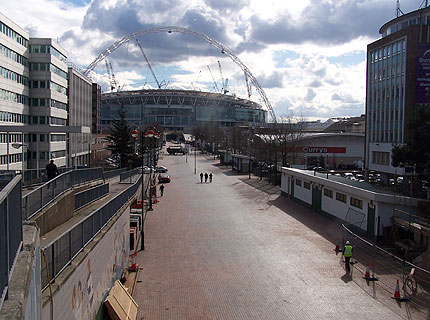
And apparently the Football Association have reached a conclusion in its talks with Multiplex, the engineering company that won the contract to build the new Wembley Stadium, which means the Australian company will now be paid the outstanding money its due and the stadium will be finished in time for next year's FA Cup Final. Well isn't that marvellous. Instead of telling them they wouldn't get a penny unless the damn thing was finished by Christmas like anyone with any pride in it's national stadium would have done, they tell them everything will be OK and 'by the way, just carry on as before - no rush lads'.
Impressive it may look as you drive along the North Circular Road and very nice it may look when it's completely finished, but surely this must teach any discerning football association around the world one simple lesson? That is if you're planning to build a venue like this, you surely must employ builders that come from the same country as that which you're building the stadium for. That way they'll have so much inherent pride in the national team they support, they'll be only to keen to get the job done well and promptly. Or am I being too simplistic about the issue?
First of all, I here that new Aston Villa owner, Randy Lerner, intends to rake in yet more money for the club by allowing a company to sponsor the name of its ground. But fear not - Lerner has said that the history and heritage of the club will be retained in any change to the name of their stadium. Apparently an early suggestion for a new title has proved controversial - it's 'Villa Park'.
I'm thinking we could see some highly commercial deals being done here. Maybe the team could be renamed Aston Martin and get them to play their games at PolyVilla Park?
Then there's the fight for the London 2012 stadium in Stratford, East London. Several clubs have been sniffing around looking to purchase the venue once its primary purpose has elapsed, but Tottenham Hotspur have now declared they're pulling out of such a move as "all grounds with a [running] track have a poor atmosphere, attendances are down and clubs say moving there was a mistake." What nonsense - it never did Brighton & Hove Albion any harm when they moved to the Withdean Stadium - or at least that's what the 1,740 miserable fans at their last home match told us.
Apparently West Ham United are now in "serious negotiations" to make it their new home - a move backed by both parties attempting a multi-millionaire takeover of the club. Speaking as a fan of the Hammers myself, I think it will be a lot more accessible for large crowds than Upton Park currently is, but it has to be said that the 'running track / atmosphere' issue is something that has to be given serious consideration.
And apparently the Football Association have reached a conclusion in its talks with Multiplex, the engineering company that won the contract to build the new Wembley Stadium, which means the Australian company will now be paid the outstanding money its due and the stadium will be finished in time for next year's FA Cup Final. Well isn't that marvellous. Instead of telling them they wouldn't get a penny unless the damn thing was finished by Christmas like anyone with any pride in it's national stadium would have done, they tell them everything will be OK and 'by the way, just carry on as before - no rush lads'.
Impressive it may look as you drive along the North Circular Road and very nice it may look when it's completely finished, but surely this must teach any discerning football association around the world one simple lesson? That is if you're planning to build a venue like this, you surely must employ builders that come from the same country as that which you're building the stadium for. That way they'll have so much inherent pride in the national team they support, they'll be only to keen to get the job done well and promptly. Or am I being too simplistic about the issue?
Subscribe to:
Posts (Atom)