Back in the mid-1970's, English football was awash with bright young talents adding their own distinctive brand of flair, panache and skill to the game.
One of them was Stan Bowles, the Queen's Park Rangers centre-forward with a fiery temperament and a knack for scoring great goals. A talent as obvious as his was inevitably spotted by the England boss of the time, Sir Alf Ramsey, and it wasn’t long before Bowles was given the call to enter international battle for his country.
Never one for turning down the opportunity to maximise his income (as any bookmaker in West London will tell you), Bowles was only too happy to lend his name to any venture that provided him with a tidy sum of money. You can understand the delight he must have felt, then, when numerous boot manufacturers came knocking at his door, asking to be associated with the latest member of the England team.
Bowles didn’t waste any time talking to the interested parties, all of whom wanted him to wear their latest footwear, but the result of his negotiations showed a shrewdness and a sense of financial nous that no-one before had matched.
When Stan Bowles walked out onto the Wembley pitch to face the Netherlands on February 9th 1977, he wore an Adidas boot on one foot and a Gola boot on the other, having accepted money from both companies. It was his last appearance for England and a memorable one for that reason. It’s just a shame they didn’t win the match - the Netherlands won the friendly 2-0.

Friday, 29 September 2006
Thursday, 28 September 2006
Obscure Kits From British Football History #1
Yes, it's back, back, back! Following the undoubted success of the 'Obscure Kits' series during this summer's World Cup (well, sort of), we bring you the footy strips that time forgot 'British-stylee'.
And where better a place to start than with the all-time number 1 cult kit from the annals of history. The reason for its notoriety can be summed up in one word - brown. Yes folks, we give you THAT Coventry Kit from the mid-to-late-1970's.
So who was to blame for this fashion 'faux pas'? It was Admiral, one of the most well-known kit manufacturers in Britain at that time. They shot to fame in 1974 when the FA chose the Leicester-based company to produce a new England strip that would appeal to the growing commercial market. The result was the first England strip to feature stripes on the sleeves, shorts and socks, a move that prompted Jimmy Greaves to refer to them as 'pyjamas'.
The signs were obviously there from the start, but undaunted, Admiral continued to find clubs and countries from far and wide that were willing to wear their apparel, and one of them was Coventry City.
Admiral created a new range of kits in the the mid-70's which featured an alarming triple stripe that curved in from the sides of the shirt and ran all the way down to the bottom of the shorts. You may recall Wales wearing a colourful version of it in red, yellow, and green, but for Coventry it was only ever going to be the tasteful hues of sky blue, white and navy blue.
But then came that fateful day when the chairman, director and manager all sat round the table to choose a new design for the away kit. God only knows what must have been going through their minds. Perhaps they'd been out for an extra-long lunch at the pub or something. Who knows, but the result of their temporary lapse of reasoning was that Coventry City would for the next couple of years visit many of their opponents bedecked in brown, white and black. I think you'll agree, it was an absolute vision of loveliness. [IRONY.]
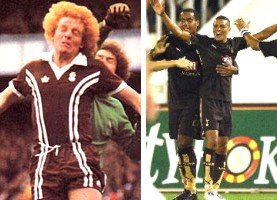
Ian Wallace (Coventry City, circa 1976) and Jermaine Jenas (Tottenham, 2006).
The odd thing is that just before the start of this season (2005/06), Tottenham resurrected the brown kit ploy thanks to their new manufacturers, Puma. With a splash of gold here or there, it looks rather more acceptable than the old Coventry strip ever did, but that colour's still rather alarming. Will we have to wait another 30 years before we see brown come back to the world of football kit design? Maybe not, if it's designed in the right way, but then that'll depend largely on whether Admiral are involved.
And where better a place to start than with the all-time number 1 cult kit from the annals of history. The reason for its notoriety can be summed up in one word - brown. Yes folks, we give you THAT Coventry Kit from the mid-to-late-1970's.
So who was to blame for this fashion 'faux pas'? It was Admiral, one of the most well-known kit manufacturers in Britain at that time. They shot to fame in 1974 when the FA chose the Leicester-based company to produce a new England strip that would appeal to the growing commercial market. The result was the first England strip to feature stripes on the sleeves, shorts and socks, a move that prompted Jimmy Greaves to refer to them as 'pyjamas'.
The signs were obviously there from the start, but undaunted, Admiral continued to find clubs and countries from far and wide that were willing to wear their apparel, and one of them was Coventry City.
Admiral created a new range of kits in the the mid-70's which featured an alarming triple stripe that curved in from the sides of the shirt and ran all the way down to the bottom of the shorts. You may recall Wales wearing a colourful version of it in red, yellow, and green, but for Coventry it was only ever going to be the tasteful hues of sky blue, white and navy blue.
But then came that fateful day when the chairman, director and manager all sat round the table to choose a new design for the away kit. God only knows what must have been going through their minds. Perhaps they'd been out for an extra-long lunch at the pub or something. Who knows, but the result of their temporary lapse of reasoning was that Coventry City would for the next couple of years visit many of their opponents bedecked in brown, white and black. I think you'll agree, it was an absolute vision of loveliness. [IRONY.]
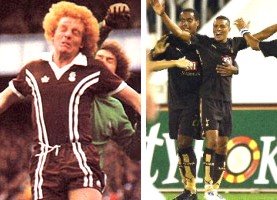
Ian Wallace (Coventry City, circa 1976) and Jermaine Jenas (Tottenham, 2006).
The odd thing is that just before the start of this season (2005/06), Tottenham resurrected the brown kit ploy thanks to their new manufacturers, Puma. With a splash of gold here or there, it looks rather more acceptable than the old Coventry strip ever did, but that colour's still rather alarming. Will we have to wait another 30 years before we see brown come back to the world of football kit design? Maybe not, if it's designed in the right way, but then that'll depend largely on whether Admiral are involved.
Wednesday, 27 September 2006
Seemed like a good idea at the time...
If you think the game of football suffers from fixture congestion these days, think again. Once upon a time, football’s stuffed shirts were practically falling over themselves to organise a whole range of competitions to appeal to the great and the good.
It all started in earnest way back in 1938 with the Empire Exhibition Trophy. This was a one-off competition that invited four English and four Scottish teams to compete in an unofficial ‘Battle of Britain’. The idea was an appealing one at a time when European tournaments were still a long way off and there was no way to test your might against foreign opposition.
Fifteen years later, the format was repeated in the similarly popular Coronation Cup. In the year of Queen Elizabeth II’s accession to the throne, eight teams gathered in Glasgow for the competition which culminated in Celtic winning outright, just as they’d done in 1938.
These were exploratory attempts at creating competitions with a commemorative bent, but the 1970’s would see a whole raft of imaginative contests that varied in necessity and significance.
The Watney Cup ran from 1970 to 1973 and was a knockout competition for the two highest-scoring teams from each division in England. As competitions go, this one was undeniably different to anything else that preceded it. For a start, some of the games in the Watney Cup were televised live, something of a rarity back in the early-1970s. Secondly, tied matches were decided by a penalty shoot-out - the first time the method had been used in a major competition anywhere in the world. And just to be even more different, the Final of the competition was staged at the ground of one of the competing teams, not at a neutral venue as is normally the case.
The Watney Cup also led the way in being one of the first competitions to be corporately sponsored. Another was the Texaco Cup, in which teams from the UK and Ireland that hadn’t qualified for Europe got the chance to play each other. Sadly, after a reasonable start that saw Wolves, Derby and Ipswich win the first few tournaments, interest waned and Texaco eventually withdrew their sponsorship.
The competition changed form slightly to become the Anglo-Scottish Cup in 1976, and was played pre-season between sides on either side of the border. Like the Texaco Cup before it, the Anglo-Scottish Cup also had a distinctive feature to help it stand out from other competitions, namely its scoring system. In addition to the ‘two points for a win, one for a draw’ way that was standard back then, English teams in the first round were also awarded three points if they scored three or more goals in a game. Something that would encourage livelier matches in the modern era, perhaps?
And if you think the habit of putting out weaker teams for low-priority tournaments is the scourge of the modern game, you’d be wrong again. In the 1977 Anglo-Scottish Cup, Newcastle United were expelled from the competition for doing just that. It wasn't long, though, before other clubs were losing interest in the Cup as the early 80’s saw more and more lower-league English teams being drafted in to make up the numbers. With only one Scottish winner of the competition - St.Mirren in 1980 - its days seemed numbered and in 1982, the competition was forced to change once again.
The Football League Group Trophy picked up where the Anglo-Scottish Cup had left off, and now it was just English teams involved from the bottom two divisions. The competition still runs to this day, however you may know it better by one of the six names that its adopted since 1984, i.e. The Freight Rover Trophy, The Sherpa Vans Trophy, The Leyland DAF Cup, The Autoglass Trophy, The Autowindscreens Shield or The LDV Vans Trophy. For good measure, the competition will take on another corporate sponsorship transformation in 2006/07 when it becomes the Jonhstone’s Paint Trophy.
Whatever you choose to call it, the competition has less interest in it these days than ever, despite offering lower-league teams the chance to play in a Millennium Stadium Final (or Wembley, as once was).
It takes a lot to persuade clubs that a new competition is worth its salt and this was never more evident than in the case of the ScreenSport Super Cup. After the Heysel Stadium disaster of 1985, six English clubs - Manchester United, Liverpool, Everton, Tottenham, Southampton and Norwich - were denied the chance to compete in Europe the following season.
As a form of sporting and financial recompense, satellite TV broadcasters ScreenSport proposed a tournament where all six teams could prove their worth against each other to fill the yawning gap in their match schedules. With the best will in the world, none of the clubs taking part could muster much enthusiasm, and when Liverpool defeated Everton in the two-legged Final, Ian Rush handed the trophy to an Everton ball-boy as he left the field, advising him to ‘put it in his bedroom’. So much for that, then.
Europe has been the focus for numerous competitions in the past, beginning in 1969 when Swindon Town, then in the Third Division, won the Football League Cup. UEFA rules dictated that no team from outside the top league of any competing country could qualify for their competitions, so in 1970 the Anglo-Italian Cup was born.
Running for just four seasons, the Anglo-Italian Cup gave lesser sides in England and Italy the chance to enjoy a modicum of European competition and in its brief history it was the English sides that tended to come out on top. Swindon, Blackpool and Newcastle all got their hands on the silverware, but in addition there was also an Anglo-Italian League Cup running in parallel which lasted until 1976. Spurs and Swindon (again) can claim to have reaped the rewards of that contest in its day.
Although the Anglo-Italian Cup made a brief comeback in the early-1990’s, it never caught the imagination and soon returned to take its place in footballing history as one of those competitions that never quite went ‘big time’. It goes to prove that for every FA Cup there’s always a Full Members Cup vying for our attention and for every Home International Championship there’s a Rous Cup skulking away in the corner.
Do we need so many tournaments in the modern game? Maybe not, but it’s fair to say that all those that have tried and failed have at least livened things up for a while. They’ve not all been worthless, especially those that tried to pioneer new developments. Just think - if the Ford Sporting League had lasted more than one season (1970-71), we could all be seeing teams getting deducted a point for unsportsmanlike behaviour these days. I wonder if anyone would have finished the season with a points total higher than zero?
It all started in earnest way back in 1938 with the Empire Exhibition Trophy. This was a one-off competition that invited four English and four Scottish teams to compete in an unofficial ‘Battle of Britain’. The idea was an appealing one at a time when European tournaments were still a long way off and there was no way to test your might against foreign opposition.
Fifteen years later, the format was repeated in the similarly popular Coronation Cup. In the year of Queen Elizabeth II’s accession to the throne, eight teams gathered in Glasgow for the competition which culminated in Celtic winning outright, just as they’d done in 1938.
These were exploratory attempts at creating competitions with a commemorative bent, but the 1970’s would see a whole raft of imaginative contests that varied in necessity and significance.
The Watney Cup ran from 1970 to 1973 and was a knockout competition for the two highest-scoring teams from each division in England. As competitions go, this one was undeniably different to anything else that preceded it. For a start, some of the games in the Watney Cup were televised live, something of a rarity back in the early-1970s. Secondly, tied matches were decided by a penalty shoot-out - the first time the method had been used in a major competition anywhere in the world. And just to be even more different, the Final of the competition was staged at the ground of one of the competing teams, not at a neutral venue as is normally the case.
The Watney Cup also led the way in being one of the first competitions to be corporately sponsored. Another was the Texaco Cup, in which teams from the UK and Ireland that hadn’t qualified for Europe got the chance to play each other. Sadly, after a reasonable start that saw Wolves, Derby and Ipswich win the first few tournaments, interest waned and Texaco eventually withdrew their sponsorship.
The competition changed form slightly to become the Anglo-Scottish Cup in 1976, and was played pre-season between sides on either side of the border. Like the Texaco Cup before it, the Anglo-Scottish Cup also had a distinctive feature to help it stand out from other competitions, namely its scoring system. In addition to the ‘two points for a win, one for a draw’ way that was standard back then, English teams in the first round were also awarded three points if they scored three or more goals in a game. Something that would encourage livelier matches in the modern era, perhaps?
And if you think the habit of putting out weaker teams for low-priority tournaments is the scourge of the modern game, you’d be wrong again. In the 1977 Anglo-Scottish Cup, Newcastle United were expelled from the competition for doing just that. It wasn't long, though, before other clubs were losing interest in the Cup as the early 80’s saw more and more lower-league English teams being drafted in to make up the numbers. With only one Scottish winner of the competition - St.Mirren in 1980 - its days seemed numbered and in 1982, the competition was forced to change once again.
The Football League Group Trophy picked up where the Anglo-Scottish Cup had left off, and now it was just English teams involved from the bottom two divisions. The competition still runs to this day, however you may know it better by one of the six names that its adopted since 1984, i.e. The Freight Rover Trophy, The Sherpa Vans Trophy, The Leyland DAF Cup, The Autoglass Trophy, The Autowindscreens Shield or The LDV Vans Trophy. For good measure, the competition will take on another corporate sponsorship transformation in 2006/07 when it becomes the Jonhstone’s Paint Trophy.
Whatever you choose to call it, the competition has less interest in it these days than ever, despite offering lower-league teams the chance to play in a Millennium Stadium Final (or Wembley, as once was).
It takes a lot to persuade clubs that a new competition is worth its salt and this was never more evident than in the case of the ScreenSport Super Cup. After the Heysel Stadium disaster of 1985, six English clubs - Manchester United, Liverpool, Everton, Tottenham, Southampton and Norwich - were denied the chance to compete in Europe the following season.
As a form of sporting and financial recompense, satellite TV broadcasters ScreenSport proposed a tournament where all six teams could prove their worth against each other to fill the yawning gap in their match schedules. With the best will in the world, none of the clubs taking part could muster much enthusiasm, and when Liverpool defeated Everton in the two-legged Final, Ian Rush handed the trophy to an Everton ball-boy as he left the field, advising him to ‘put it in his bedroom’. So much for that, then.
Europe has been the focus for numerous competitions in the past, beginning in 1969 when Swindon Town, then in the Third Division, won the Football League Cup. UEFA rules dictated that no team from outside the top league of any competing country could qualify for their competitions, so in 1970 the Anglo-Italian Cup was born.
Running for just four seasons, the Anglo-Italian Cup gave lesser sides in England and Italy the chance to enjoy a modicum of European competition and in its brief history it was the English sides that tended to come out on top. Swindon, Blackpool and Newcastle all got their hands on the silverware, but in addition there was also an Anglo-Italian League Cup running in parallel which lasted until 1976. Spurs and Swindon (again) can claim to have reaped the rewards of that contest in its day.
Although the Anglo-Italian Cup made a brief comeback in the early-1990’s, it never caught the imagination and soon returned to take its place in footballing history as one of those competitions that never quite went ‘big time’. It goes to prove that for every FA Cup there’s always a Full Members Cup vying for our attention and for every Home International Championship there’s a Rous Cup skulking away in the corner.
Do we need so many tournaments in the modern game? Maybe not, but it’s fair to say that all those that have tried and failed have at least livened things up for a while. They’ve not all been worthless, especially those that tried to pioneer new developments. Just think - if the Ford Sporting League had lasted more than one season (1970-71), we could all be seeing teams getting deducted a point for unsportsmanlike behaviour these days. I wonder if anyone would have finished the season with a points total higher than zero?
Tuesday, 26 September 2006
If Carling did giant killings...
In case you missed it, the Carling Cup Third Round draw was made on Saturday. This is the stage where the teams competing in Europe enter the competition.
The thing that strikes me about this draw is the great chance for a smaller or non-premiership club going all the way. In the previous round, Fulham, Manchester City, Middlesborough and Wigan all took an early bath, and this Third Round draw will see a few more premiership teams eliminated due to all premiership fixtures.
Blackburn v Chelsea looks like the pick of the bunch, although Newcastle v Portsmouth has potential. Charlton host Bolton and Liverpool host Reading.
For other premiership clubs, there are some tricky looking fixtures, or ‘potential banana skins’ as Richard Keys would say. Crewe v Manchester United and West Brom v Arsenal may not sound too tricky for the premiership ‘giants’, but with Champions League action abound it may mean the return of the ‘reserve squad’ routines from them both.
In form Spurs take there impressive away record all the way to Milton Keynes to play the Dons, West Ham travel to Chesterfield and Leicester host the Midands derby with ‘The Villa’.
For some reason, Leeds v Southend catches my eye, but I cant work out why...
The draw in full >>>
Ties to be played the week commencing 23 October, once Sky Sports have selected their favourites for a giant-killing. I predict the Sky TV outside broadcasting units will be heading towards Milton Keynes…
The thing that strikes me about this draw is the great chance for a smaller or non-premiership club going all the way. In the previous round, Fulham, Manchester City, Middlesborough and Wigan all took an early bath, and this Third Round draw will see a few more premiership teams eliminated due to all premiership fixtures.
Blackburn v Chelsea looks like the pick of the bunch, although Newcastle v Portsmouth has potential. Charlton host Bolton and Liverpool host Reading.
For other premiership clubs, there are some tricky looking fixtures, or ‘potential banana skins’ as Richard Keys would say. Crewe v Manchester United and West Brom v Arsenal may not sound too tricky for the premiership ‘giants’, but with Champions League action abound it may mean the return of the ‘reserve squad’ routines from them both.
In form Spurs take there impressive away record all the way to Milton Keynes to play the Dons, West Ham travel to Chesterfield and Leicester host the Midands derby with ‘The Villa’.
For some reason, Leeds v Southend catches my eye, but I cant work out why...
The draw in full >>>
Ties to be played the week commencing 23 October, once Sky Sports have selected their favourites for a giant-killing. I predict the Sky TV outside broadcasting units will be heading towards Milton Keynes…
Subscribe to:
Posts (Atom)